
Crypto Rally Meets Regulatory Clarity in August 2026

August 2026 marked a turning point for the cryptocurrency market, as Bitcoin surged past $77,000 amid renewed investor optimism and pivotal regulatory developments. The flagship digital asset gained over 22% in a single week, reaching its highest level in three months, while Ethereum also climbed above $2,400.
A major catalyst was President Trump's push for the Clarity Act, legislation designed to define whether cryptocurrencies should be regulated as securities or commodities. Although the bill remains stalled in the Senate, the SEC responded by proposing its first permanent digital-asset rule on August 18, offering exemptions for smaller token sales and clearer guidelines for capital raises. This regulatory momentum was further bolstered by a White House summit on August 19, where Trump met with executives from Coinbase, Ripple, and Robinhood to discuss the industry's future.
Institutional adoption accelerated alongside these developments. U.S. Bitcoin ETFs recorded approximately $650 million in net inflows during the month, with one week alone seeing $2.6 billion—the strongest inflow week since October. Mastercard's $1.8 billion acquisition of stablecoin firm BVNK and Tether's completion of a KPMG audit underscored growing mainstream confidence.
Meanwhile, the Treasury Department proposed rules implementing the GENIUS Act to regulate stablecoin issuers, while over $705 million in token unlocks from projects like Humanity and Huma Finance were scheduled for the final week of August.
Disclaimer: This is not financial advice but for information and educational purpose only.
Can Crypto Be Useful in an Economic Crisis?

When an economy is under stress, people often look for assets that can protect their savings. Cryptocurrency, especially Bitcoin, is sometimes seen as one option because it is decentralized, limited in supply, and not controlled by a central bank. In countries facing currency devaluation or capital controls, crypto can offer a way to move money, preserve purchasing power, and access global markets.
That said, crypto is not a perfect safe haven. Research shows that Bitcoin may perform more like a hedge during local currency crises than during global market shocks. In other words, it can be useful when a national currency weakens, but it may still fall sharply when markets panic worldwide. Its volatility remains a major risk, especially for people who need stability rather than speculation.
Crypto can also help in practical ways during a crisis. It may support cross-border payments, reduce dependence on fragile banking systems, and give people in underbanked regions more access to financial services. Stablecoins, in particular, can be useful for everyday transactions because their value is tied to traditional currencies.
Overall, crypto can be useful in an economic crisis, but only in specific situations. It works best as a tool for diversification, payments, or short-term protection against local currency weakness. It should not be treated as a guaranteed shield against recession, inflation, or market collapse.
Disclaimer: This is not financial advice but for information and educational purpose only.
Is Crypto Fit for the Informal Economy?

The informal economy includes work and businesses that operate outside full legal, tax, or regulatory coverage, even when the goods and services are legitimate. It matters because it supports millions of livelihoods, especially where formal banking and business infrastructure are limited.
Crypto can be fit for the informal economy when it has real utility, low fees, and easy access on mobile devices. For unbanked workers and small traders, utility tokens can help with faster payments, cross-border transfers, and storing value without needing a traditional bank account. This can make it easier to buy stock, pay suppliers, and keep cash flowing.
A useful example is XLM, Bitcoin, and XRP, which are often discussed in the context of faster payments, cross-border transfers, and everyday transaction use. While XLM is designed for low-cost transfers, Bitcoin is widely recognized as a digital asset with global reach, and XRP is often associated with payment settlement and remittances. The key point is that utility-focused crypto can solve practical business problems, not just serve as a speculative asset.
That said, crypto is not a complete solution. People in the informal economy still need simple onboarding, price stability, consumer protection, and clear rules so digital assets do not add extra risk.
Disclaimer: This is for educational purposes only and is not investment advice.
Is Rayls Network (RLS) in competition with Xinfin (XDC) and Stronghold (SHX)?
Light purple, yellow, and black color.
The future of digital finance is being shaped by blockchain projects that want to solve different parts of the same problem: moving value faster, cheaper, and with more trust. Rayls Network, XDC Network, and Stronghold SHX all fit into this conversation, but each approaches it from a different angle.
Rayls (RLS) is the newest of the three and is built around a hybrid model that connects private financial networks with public blockchain liquidity. Its pitch is clearly institutional: privacy, compliance, and a path for traditional finance to interact with DeFi without giving up control.
XDC Network has been in the market longer and focuses on enterprise use cases such as trade finance, tokenization, and hybrid public-private infrastructure. It is designed for organizations that need blockchain benefits while preserving data confidentiality and auditability.
Stronghold SHX sits closer to the payments layer. Its story is about enabling efficient global settlement and bridging traditional finance with digital asset rails, making it a practical option for payments and remittances rather than broad enterprise infrastructure.
So, are they competing? Yes, but mostly at the level of narrative and market opportunity. They all want a role in the future of financial infrastructure, yet Rayls leans institutional-compliance, XDC leans enterprise tokenization, and SHX leans payments and settlement.
Disclaimer: This is for educational purposes only and is not investment advice.
Bitcoin vs Business and Real Estate

A bitcoin sitting on top of a pile of gold nuggets
Bitcoin, business, and real estate are three very different ways to store and grow wealth. Each has strengths, but they serve different purposes. Bitcoin is often described as a store of value because it is scarce, portable, and easy to transfer.
In that sense, it can be compared to keeping something valuable in a school locker or a post box: the value is stored securely until you need it. Bitcoin’s appeal comes from its limited supply and global accessibility, which make it attractive to people looking for a digital asset that is not tied to one location.
Business ownership, on the other hand, can create cash flow and long-term growth. A business can generate income, employ people, and expand over time. Unlike Bitcoin, a business is productive by nature. It requires management, strategy, and risk-taking, but it can also produce ongoing earnings that Bitcoin does not generate on its own.
Real estateis another powerful asset class. Property can provide rental income, capital appreciation, and a hedge against inflation. It is tangible and often easier for people to understand than digital assets. However, real estate usually comes with taxes, maintenance, location risk, and lower liquidity compared to Bitcoin.
The key difference is this: Bitcoin is mainly a store of value, while business and real estate are often productive assets. Bitcoin may be easier to buy, sell, and move, but it does not produce income by itself. Businesses and properties may cost more to own, but they can generate returns through operations or rent.
In short, Bitcoin, business, and real estate are not direct replacements for one another. They belong to different parts of a wealth strategy.
Disclaimer: This is for educational purposes only and is not investment advice.
Ripple’s Momentum: RLUSD Shines, XRP Fluctuating

March 2026 brought encouraging developments across the Ripple ecosystem, with RLUSD taking center stage and Ripple’s institutional adoption gaining traction. While XRP’s price fluctuated throughout the month, a late uptick hinted at renewed optimism.
Ripple reported a record-breaking Q1, with growing engagement from banks and financial institutions. Much of this activity flowed through Ripple’s infrastructure, with settlements increasingly favouring RLUSD and fiat—signalling real-world utility and confidence in Ripple’s technology.
RLUSD stood out as the ecosystem’s brightest spot. The regulated stablecoin reached a $1.56 billion market cap, passed a Deloitte audit confirming full backing, and launched a trade finance pilot in Singapore. Its feature at Consensus 2026 further solidified its reputation as a trusted, compliant digital asset.
XRP, meanwhile, experienced a choppy start to the month, continuing its pattern of early-year volatility. However, by late March, it climbed back to the $1.41–$1.42 range, setting up its first potential positive monthly close of 2026. While the token’s price didn’t fully reflect Ripple’s operational momentum, the recovery offered a hopeful signal for the months ahead.
In sum, March showcased Ripple’s growing institutional relevance and RLUSD’s rapid ascent. Even as XRP’s price moved unevenly, the broader ecosystem demonstrated resilience and strategic progress.
Disclaimer: This article is for informational and educational purposes only and does not constitute financial advice.
Are Yellow Network and World Liberty Financial Competing with Ripple?

Ripple, Yellow Network, and World Liberty Financial all aim to improve how value moves across digital systems, but they operate in different lanes. While their goals overlap around reducing payment friction and lowering fees, their technologies and target users differ significantly.
Ripple focuses on institutional payments through the XRP Ledger, a high‑speed blockchain designed for low‑cost settlement. XRP acts as a bridge asset, removing the need for pre‑funded accounts in cross‑border transfers. Ripple is also expanding into stablecoins, including RLUSD and support for USDC on XRPL, giving banks and enterprises more compliant, real‑time settlement options. Its mission is clear: reduce liquidity costs, eliminate delays, and modernize global remittances.
Comparison of the Three Projects
Ripple (XRP + RLUSD Stabecoin) — Built for banks and enterprises. XRP enables fast settlement and liquidity efficiency, while Ripple’s stablecoins support regulated, low‑fee cross‑border payments.
Yellow Network (YELLOW Token) — Designed for decentralized trading infrastructure. The YELLOW token powers network security, liquidity incentives, and cross‑exchange order routing. Its focus is solving fragmented liquidity and high trading fees across crypto markets, not replacing traditional payment rails.
World Liberty Financial (USD1 + Governance Token) — Introduces the USD1 stablecoin for simple digital payments. However, its utility mechanisms are early and less defined, and it does not match Ripple’s institutional integrations or Yellow’s technical specialization.
Are They Competing with Ripple?
Only in a broad sense. Ripple targets institutional payments, Yellow Network targets decentralized liquidity and trading, and World Liberty Financial targets consumer‑level stablecoin payments. They all address inefficiencies in digital value transfer, but Ripple remains the most established in solving cross‑border fees, settlement delays, and liquidity challenges at scale.
How To Stay Vigilant with Crypto Presales

A close up of a camera on a table
Crypto presales often lure investors with polished websites and whitepapers, but beneath the surface many conceal deceptive agendas. Staying vigilant means looking past appearances, questioning motives, and understanding how regulatory frameworks and real-world cases highlight the risks.
🚨 The Deception of Crypto Presales
Presales promise early access to tokens at discounted rates, but many fail to deliver. Scammers exploit hype, presenting sleek branding and professional whitepapers to mask weak fundamentals.
🎭 Appearance vs. Substance
A polished website or whitepaper does not equal legitimacy. Substance lies in transparent roadmaps, credible teams, and verifiable partnerships. Investors must resist the temptation to equate design with trustworthiness.
🎯 Project Agendas and Motives
Every presale has an agenda—whether funding genuine development or simply enriching founders. If motives are unclear or overly focused on marketing rather than utility, caution is warranted.
⏳ Token Generation Events (TGEs)
TGEs mark the official release of tokens. Delays often signal deeper issues: lack of funding, poor planning, or outright fraud. Repeated postponements are a red flag that scammers use to stretch investor patience.
🕒 How Scammers Exploit Investor Patience
Fraudulent projects weaponize time, promising “soon” while dragging out TGEs. This tactic keeps investors hopeful while funds are siphoned away.
⚖️ UK Regulatory Context
The UK’s Financial Conduct Authority (FCA) is expanding oversight of cryptoassets under the Financial Services and Markets Act 2000 (Cryptoassets) Regulations 2025, set to commence in October 2027. These measures aim to strengthen consumer protection and require firms to be authorized before offering presales.
📚 Case Studies: Real-World Examples
Examples abound: projects that raised millions in presales but never launched, or tokens that collapsed immediately after TGEs.
Cointelegraph: Crypto Presale Scams and Red Flags
Investopedia: 10 Red Flags of Crypto Presale Scams
Decrypt: AI-Generated Scam Projects
✅ Practical Tips to Verify a Presale
Check team credentials
Audit reports from independent firms
Regulatory compliance with FCA rules
Community feedback in transparent forums
📢 Call to Action
Education is the strongest defence. Report suspicious projects to regulators, share knowledge within communities, and consult trusted resources like the FCA’s crypto guidance.
Disclaimer:
This article is for educational purposes only and does not constitute investment advice.
Wishing You a Joyous Christmas and a Joyous New Year 2026

As we celebrate this festive season, let us reflect on the true purpose of Jesus’s birth: to save us from our sins and grant us new life in Him. We are grateful for the incredible gift of His love and sacrifice.
I extend warm wishes to everyone—whether you are a crypto enthusiast or part of the XRP community—for a truly joyous Christmas and a prosperous New Year in 2026. As we close out 2025, let us give thanks to God through our Lord Jesus Christ for the victories we have achieved despite the challenges.
Remember to embrace the true gift of Jesus Christ, our Saviour and Lord, for only He can provide us with the satisfaction we seek. Wishing you all the best in 2026—stay safe and be vigilant against scammers!
A Third Category: UK Law Recognises Digital Assets as Property

Red double decker bus passing palace of Westminster London during daytime
On 2nd December 2025 the Property (Digital Assets etc) Act 2025 received Royal Assent, formally confirming that qualifying digital assets can be objects of personal property rights under UK law.
The Act removes uncertainty by stating that a “thing (including a thing that is digital or electronic in nature) is not prevented from being the object of personal property rights merely because it is neither a thing in possession nor a thing in action,” effectively creating a statutory “third category” of property.
Industry groups and advocates welcomed the change. Bitcoin Policy UK called it a landmark that gives legal protection to holders, while Crypto UK highlighted clearer routes for recovery after theft, inclusion in insolvency and estate processes, and stronger foundations for tokenisation and innovation.
Parliament’s passage of the Act follows Law Commission recommendations and aims to replace inconsistent case‑by‑case rulings with a consistent statutory framework that courts can develop over time.
The Act’s practical effects include improved legal certainty for ownership, recovery, and transfer of crypto‑tokens and NFTs, and clearer treatment in bankruptcy and probate.
Administrators, custodians and platforms will now operate with a firmer legal basis, which could encourage institutional participation and product development in the UK’s digital asset market. However, the Act leaves detailed boundaries and rights to judicial development, meaning litigation and regulatory guidance will still shape how the new category functions in practice.
Key considerations and next steps
Confirm asset classification: Not every digital item will automatically qualify; courts will delineate the scope.
Custody and contracts: Firms should review custody models and contractual terms to align with property treatment.
Estate and insolvency planning: Individuals and advisors should update wills and recovery plans to reflect property status.
Risks and limitations
Statutory recognition does not eliminate all uncertainty: judicial interpretation, cross‑border enforcement, and regulatory regimes (e.g., financial regulation) will continue to affect outcomes. Stakeholders should monitor case law and regulatory guidance as the new framework is tested in disputes.
This article is for informational and educational purposes only and is not financial advice.
Ripple's RLUSD Recognition and XRP ETF Momentum
Source: X.com
The U.S. market saw a rapid succession of XRP exchange-traded funds in late 2025, with multiple issuers bringing spot and structured products to major exchanges. Asset managers launched a range of vehicles — from pure spot funds to income-focused strategies — including high-profile entries such as the Franklin XRP Trust, Bitwise’s XRP ETF, and several others that debuted across NYSE, Nasdaq, and Cboe in October–November 2025.
These launches created fresh institutional on‑ramps to XRP exposure, with some funds securing prominent tickers and fee waivers to attract early inflows. Market observers noted heavy initial trading volumes and a mix of spot and futures-based offerings that together broadened investor access to XRP through traditional brokerage accounts.
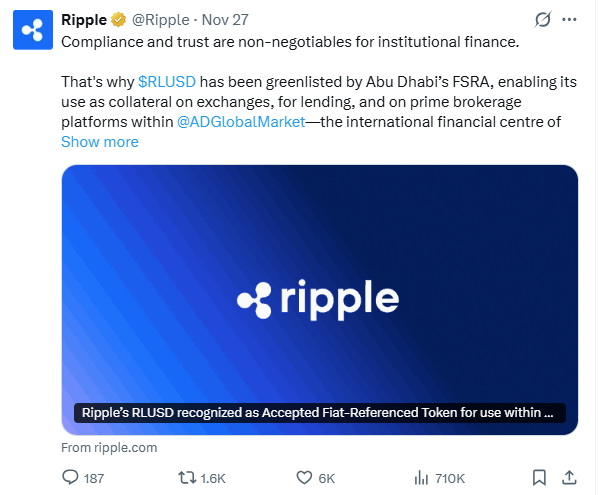
In parallel, Ripple achieved a regulatory milestone in the Middle East. On 27 November 2025, the Financial Services Regulatory Authority of Abu Dhabi Global Market (ADGM) recognized Ripple USD (RLUSD) as an Accepted Fiat-Referenced Token, enabling its use by FSRA‑authorised firms within ADGM for activities such as trading, settlement, collateral, and treasury operations. Ripple described the designation as a validation of RLUSD’s compliance framework — including 1:1 USD backing, third‑party attestations, and NYDFS oversight — and said the approval supports enterprise use cases across the region.
Taken together, the U.S. ETF wave and ADGM’s RLUSD recognition signal a two‑front expansion: broader retail and institutional access to XRP in the U.S. and regulated stablecoin utility for institutional actors in the UAE. Both developments underscore growing regulatory engagement and product innovation around Ripple’s ecosystem, though they also introduce new liquidity dynamics and market risks for token holders and ETF investors.
Important: This summary is informational only and not financial or investment advice; crypto markets carry significant risk and readers should conduct their own due diligence before acting.
Ripple Prime Debut; Western Union Goes Solana
CEO of Ripple Brad Garlinghouse
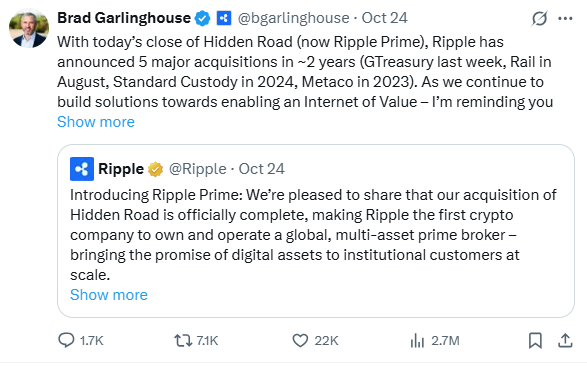
Ripple completed its acquisition of Hidden Road on 24 October 2025, rebranding the business as Ripple Prime—a global multi-asset prime broker aimed at institutional clients.
The deal makes Ripple the first crypto company to own and operate prime-broker infrastructure, strengthening its push to bring digital assets to banks and financial institutions at scale. Ripple’s CEO highlighted a string of strategic acquisitions in recent years and reiterated that XRP remains central to the company’s Internet of Value strategy.

Days later, on 28 October 2025, Solana announced Western Union will build exclusively on its network, signalling traditional finance’s growing embrace of blockchain rails.
Together these moves show institutions shifting from experimentation to production and adopting different chains to solve distinct needs: institutional settlement and custody Ripple Prime, high-throughput payments for Solana.
The landscape is fragmented but accelerating, and the lesson for investors is to focus on real utility, regulatory clarity, interoperability as adoption widens.
Why Depin Is the Infrastructure of Crypto

Green typewriter with paper and letter
Depin projects build real-world infrastructure by attaching unique utilities to tokens and hardware rather than offering a one-size-fits-all solution.
Geodnet creates a blockchain-based precise positioning layer, letting participants host receivers that improve location accuracy while earning rewards.
Onocoy focuses on global, community-powered GNSS data sharing, unlocking high-precision positioning for mapping, autonomous systems, and location-based services.
Nubila pairs its Marco devices with a decentralized weather oracle: owners collect tamper-proof meteorological data used for parametric insurance and forecasting while validating entries through Nubila Nodes.
SkyX’s SKY-100 personal weather station supplies hyper-local measurements—temperature, humidity, pressure, wind—and compensates users for sharing that real-time data.
Beamable Network shifts gaming infrastructure onto decentralized nodes: operators run Beamable Nodes to power multiplayer services, in-game purchases, and live operations. Warp Gaming uses Warp Nodes to secure a decentralized publishing layer, validating transactions and publishing activity to protect creators and players.
Mawari Network relies on Guardian Nodes that validate and audit network activity, ensuring transparency and operational trust across its ecosystem.
Each project targets a specific infrastructure need—GPS accuracy, weather data, gaming backends, or auditing—making DePIN a collection of interoperable utilities rather than a single protocol. Participants either install devices or run nodes to earn rewards and directly contribute to service resilience and data integrity.
This model anchors crypto value in tangible services.

This not financial or investment advice. Do your own research.
XRP Card Meets Depin: Utility in Motion

Source:X.com
On August 25, 2025, Gemini unveiled its XRP Edition credit card, tailored for crypto enthusiasts eager to earn XRP with everyday purchases. While the card’s core functionality mirrors existing Gemini cards—offering rewards in Bitcoin or 50+ cryptocurrencies—it features a bold design for the XRP Army to showcase their allegiance. As Gemini notes, users can swap rewards anytime, adding flexibility to loyalty.
Ripple CEO Brad Garlinghouse celebrated the launch on X, tweeting, “An XRP rewards credit card out in the world?! What a time to be alive, XRP family…”
Beyond aesthetics, the card’s release echoes the ethos of Depin—decentralized physical infrastructure networks that use token incentives to power real-world systems. By rewarding users with XRP, Gemini reinforces the token’s utility, bridging digital finance with tangible value. It’s a promising signal for Ripple’s mission and the broader blockchain movement toward solving real-world problems.
Ripple Rises: Rail Acquisition & SEC Case Closed

Source:X.com
On August 7, 2025, Ripple CEO Brad Garlinghouse revealed the company’s $200 million acquisition of Rail Financial—a stablecoin-powered platform designed to streamline global payments. This strategic move positions Ripple to expand its reach in cross-border transactions, leveraging Rail’s infrastructure to accelerate adoption of XRP and stablecoin solutions.

Source:X.com
Just days earlier, on August 4, SEC Chairman Paul S. Atkins declared, “America will be the crypto capital of the world,” during his Project Crypto speech. Under President Trump’s leadership, the SEC launched Project Crypto, a sweeping initiative to bring U.S. financial markets on-chain and foster blockchain innovation.
Source:X.com
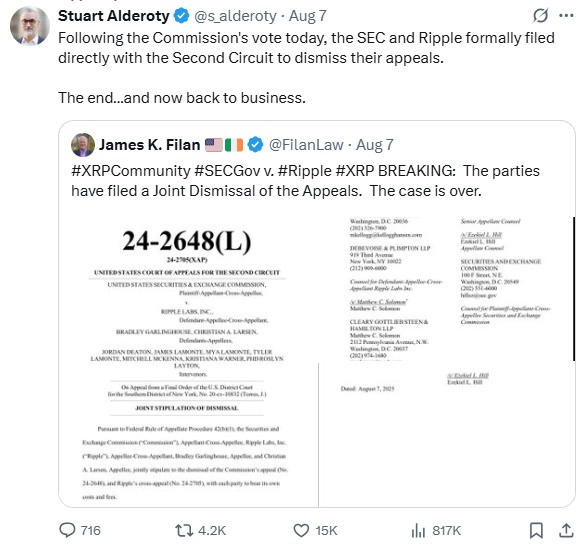
Adding to the momentum, Ripple and the SEC jointly filed to dismiss their long-standing legal appeals, officially ending the high-profile case. James K. Filan of Filan Law broke the news, with Ripple’s Chief Legal Officer Stuart Alderoty confirming: “The end… and now back to business.”
With regulatory clarity and a powerful new acquisition, Ripple is poised to lead the next wave of crypto-financial integration. The timing couldn’t be better—for Ripple, XRP holders, and the broader blockchain ecosystem.
RLUSD Crowned Number 1 Stablecoin as GENIUS Act Reshapes Crypto Regulation
Source: X.com
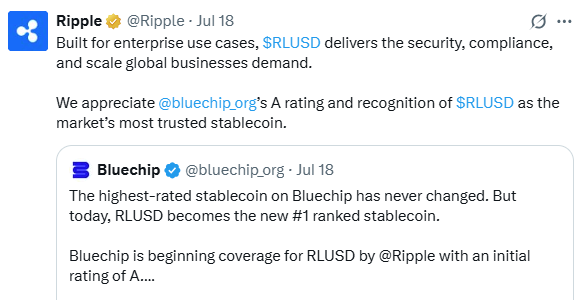
On July 18, 2025, RLUSD by Ripple surged to the top of Bluechip’s stablecoin rankings, earning an initial “A” rating and claiming the number 1 spot for safety and reliability. Known for its dollar-backed structure and regulatory transparency, RLUSD’s ascent marks a major leap in financial trust.
Source: X.com
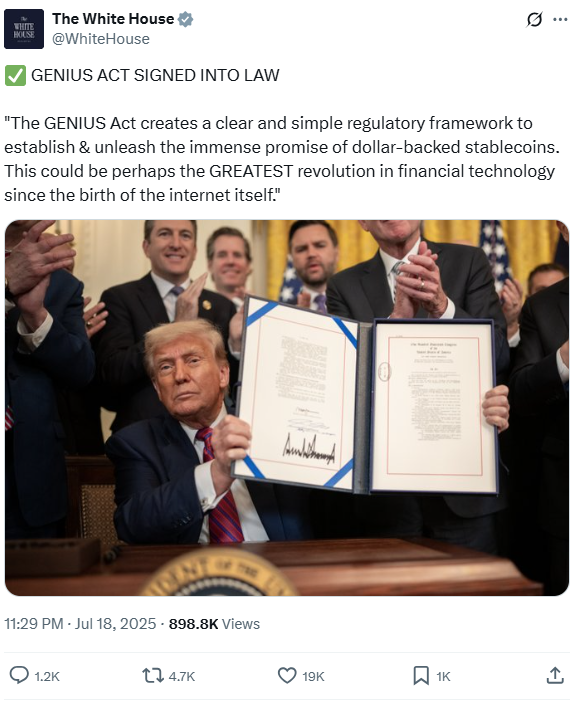
This announcement arrived just as President Trump signed the GENIUS Act into law—hailed as a transformative move for crypto innovation. Following the Financial Services GOP’s approval of the Clarity, Genius.1582, and Anti-CBDC Surveillance State Acts, the GENIUS Act introduces a clear framework designed to unleash the full potential of dollar-backed stablecoins.
Described as “the greatest revolution in financial technology since the birth of the internet,” this dual development—RLUSD’s top ranking and the GENIUS Act’s passage—signals a new era for blockchain finance, rooted in clarity, credibility, and innovation.
Crypto Week Victory: U.S. Passes CLARITY, GENIUS, and Anti-CBDC Acts to Lead Global Digital Finance

Source: X.com
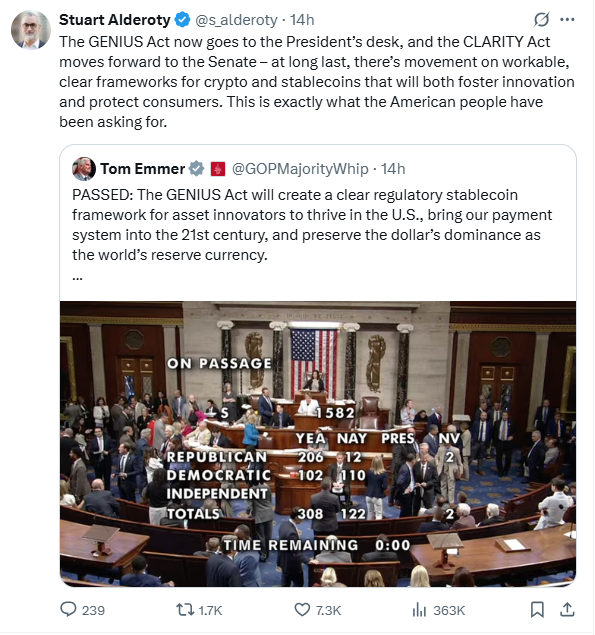
Crypto Week 2025 delivered a seismic shift in the digital finance landscape. On July 17, the U.S. House passed a trio of groundbreaking bills—the CLARITY Act, GENIUS Act (S.1582), and Anti-CBDC Surveillance State Act—designed to restore America’s leadership in blockchain innovation, protect consumer privacy, and provide long-awaited regulatory clarity. For the crypto community, this marks a pivotal moment where innovation is embraced and surveillance is rejected.
On July 17, 2025, the U.S. House of Representatives passed a transformative package of crypto legislation, marking a historic moment for digital finance. Dubbed “Crypto Week,” the trio of bills—the CLARITY Act, the GENIUS Act (S.1582), and the Anti-CBDC Surveillance State Act—aim to restore America’s leadership in blockchain innovation, stablecoin regulation, and financial freedom.
Source: X.com
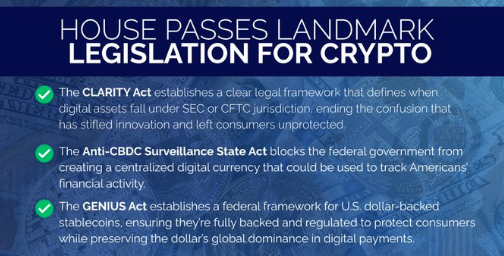
The CLARITY Act establishes clear definitions for digital assets, resolving the long-standing turf war between the SEC and CFTC. It classifies tokens as either securities or commodities, protects self-custody rights, and creates pathways for decentralized projects to operate legally.
The GENIUS Act sets federal standards for stablecoin issuers, requiring 1:1 asset backing, monthly reserve disclosures, and strict consumer protections. It empowers banks and fintechs to issue stablecoins under clear regulatory oversight, fostering trust and innovation.
The Anti-CBDC Surveillance State Act blocks the Federal Reserve from issuing or testing a central bank digital currency (CBDC) without Congressional approval. It safeguards privacy by banning programmable digital dollars that could enable government surveillance.
Source: X.com
Ripple’s leadership hailed the bills as a turning point. Brad Garlinghouse called it “transformational,” while Stuart Alderoty emphasized the long-awaited clarity. With innovation protected and surveillance rejected, the U.S. is poised to lead the next era of digital finance.
Ripple Rises: XRP Earns ETF Status, RLUSD Gains Trust, and Garlinghouse Speaks Out

Source:Sec.gov
On July 8, 2025, XRP joined the prestigious list of Truth Social Crypto Blue Chip ETFs. The portfolio breakdown includes: 70% Bitcoin, 15% Ethereum, 8% Solana, 5% Cronos, and 2% XRP. While XRP holds a smaller percentage, its inclusion signals growing recognition and confidence from institutional circles.
The next day, Ripple announced via X.com that BNY Global — a financial titan renowned for reliability — was selected as the primary custodian for RLUSD, Ripple’s enterprise-grade stablecoin. This move cements RLUSD’s commitment to regulatory compliance and long-term stability, aiming for real-world utility across global markets.

Source:Bny.com
Also on July 9, Ripple CEO Brad Garlinghouse testified before the U.S. Senate Banking Committee. Reflecting on Ripple’s historic legal battle, he stated, “Ripple was the first leading U.S. company to be sued by the SEC… Fortunately, after four years of a hard fought legal battle, we prevailed.”

Source:X.com
Together, these developments mark a strategic trifecta — ETF validation, institutional partnerships, and public policy engagement — reinforcing Ripple’s upward trajectory and its intent to shape the future of digital finance.
Ripple Moves Toward Bank Status, Sets Stablecoin Standard

Source:X.com
On July 2, 2025, Ripple’s CEO Brad Garlinghouse announced a transformative step: Ripple has applied for a national bank charter from the U.S. Office of the Comptroller of the Currency (OCC).
If granted, this would place Ripple under both state and federal regulatory frameworks—a first in the stablecoin space. Additionally, through Standard Custody, Ripple has applied for a Federal Reserve Master Account, enabling direct custody of RLUSD reserves.
These moves signal Ripple’s commitment to regulatory transparency and long-term trust, crucial in a market exceeding $250 billion. Amid evolving crypto legislation, Ripple’s proactive stance could redefine institutional expectations. RLUSD, its stablecoin, gains an edge by aligning early with compliance benchmarks.
For the XRP community, this isn’t just good news—it’s a validation of Ripple’s vision to bridge the gap between blockchain innovation and traditional finance with integrity at its core.
Ripple and SEC Drop Appeals, Marking End of Legal Saga

Source:X.com
On June 26, 2025, the prolonged legal clash between Ripple Labs and the U.S. Securities and Exchange Commission (SEC) took a decisive turn.
Judge Analisa Torres denied both parties’ Motion for an Indicative Ruling, prompting Ripple’s Chief Legal Officer Stuart Alderoty to reaffirm that XRP's legal status as not a security remains unchanged. “It’s business as usual,” Alderoty posted, assuring the community.

Source:X.com
Ripple CEO Brad Garlinghouse followed up with a statement confirming that Ripple is dropping its cross appeal, while the SEC is expected to do the same.
“We’re closing this chapter once and for all,” he wrote on X.com, signaling the company's renewed focus on building the Internet of Value.
This decision brings long-awaited clarity to the XRP community and the broader crypto industry, allowing Ripple to shift fully from courtroom battles to technological innovation and global adoption.